 العربية
 Български
 繁體中文
 Hrvatski
 Čeština
 Dansk
 Nederlands
 English
 Suomi
 Français
 Français
 ქართული
 Deutsch
 Ελληνικά
 עברית
 हिन्दी
 Magyar
 Íslenska
 Bahasa Indonesia
 Italiano
 日本語
 한국어
 ລາວ
 Norsk
 Polski
 Português
 Português
 Русский
 Srpski
 Slovenčina
 Español
 Español
 Svenska
 ไทย
 Türkçe
 Tiếng Việt
The first-visit panel
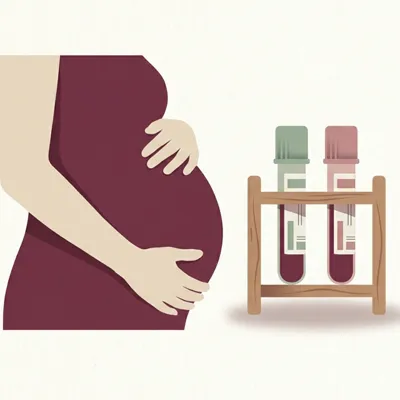
Prenatal blood tests start at the first visit, usually in the first trimester, with a group of tests often called a prenatal or OB panel. You do not need to fast or prepare for it, and the draw carries no risk to the baby.
Most of these tests are not about how you feel today. They look for things that can be treated or planned for: anemia, a blood group that could react against the baby’s, or an infection that could pass to the baby during pregnancy or birth. Many problems found this way can be treated during the pregnancy itself.
- Complete blood countCounts red cells, white cells and platelets. It screens for anemia, infection and clotting problems; see how to read a complete blood count.
- Blood type and Rh factorYour group (A, B, AB or O) and whether you are Rh positive or negative.
- Rubella immunityShows whether you are protected by vaccination or a past infection.
- InfectionsHepatitis B, hepatitis C, HIV and syphilis are checked in everyone.
Which test comes when
The calendar below follows the American College of Obstetricians and Gynecologists (ACOG). Your practice may add tests depending on your history, where you live or your results, so treat it as a map rather than a rule.
| When | Blood test | What it looks for |
|---|---|---|
| First visit | Complete blood count | Anemia, infection, clotting problems |
| First visit | Blood type and Rh factor | Rh incompatibility with the baby |
| First visit | Hepatitis B and C, HIV, syphilis, rubella | Infections that can reach the baby; rubella immunity |
| From 10 weeks | Cell-free DNA (optional) | Down syndrome, trisomies 13 and 18, sex chromosome differences |
| 10 to 13 weeks | First-trimester screen (optional) | Two blood markers read with an ultrasound measurement |
| 15 to 22 weeks | Quad screen (optional) | Four blood markers: Down syndrome, trisomy 18, neural tube defects |
| 24 to 28 weeks | Glucose test | Gestational diabetes; earlier if you have risk factors |
| Third trimester and delivery | Repeat syphilis test | A new infection since the first visit |
Blood type, Rh factor and infections
The “positive” or “negative” in a blood type such as O positive is the Rh factor, a protein on the surface of red cells. If you are Rh negative and the baby is Rh positive, your body can make antibodies that damage the baby’s red cells. A first pregnancy is rarely affected, because few antibodies are made, but a later one can be. That is why Rh-negative mothers may receive a medicine during pregnancy that prevents these antibodies from forming.
The infection tests follow national recommendations. The US Preventive Services Task Force recommends testing for hepatitis B at the first prenatal visit, and the CDC recommends testing for hepatitis C during each pregnancy. ACOG advises testing for syphilis three times: at the first visit, in the third trimester and at delivery. A positive result is not a verdict: these infections can be treated or managed, and a baby born to a mother with hepatitis B receives a first vaccine dose within a few hours of birth.
Screening for chromosomal conditions
These tests are optional. ACOG says both screening and diagnostic testing are offered to all pregnant women, and that choosing either, or neither, is a personal decision.
A screening test gives a chance, not an answer. Cell-free DNA, drawn from 10 weeks, reads small fragments of placental DNA in your blood. The first-trimester screen, between 10 and 13 weeks, combines two blood markers with an ultrasound. The quad screen, between 15 and 22 weeks, measures four substances. A positive cell-free DNA result should be confirmed with a diagnostic test, amniocentesis or chorionic villus sampling, before any decision is made.
Results that change because you are pregnant
This is where a pregnancy lab report most often misleads. A 2021 review points out that most laboratories still print non-pregnant adult ranges on pregnancy results, although thyroid, liver, kidney, blood count and other markers all shift with each trimester. A value flagged on your report may simply be normal for pregnancy, and the reverse can also happen. The same logic explains why ranges differ by sex and age outside pregnancy.
A 2024 analysis of healthy people put the hemoglobin floor at about 11.0 g/dL in the first trimester and 10.6 g/dL in the second, against 12.0 g/dL outside pregnancy. Part of the drop comes from blood volume growing by 30 to 50%, which dilutes the red cells. Iron is a separate question: if your hemoglobin is low, ask whether your iron tests were checked too.
Platelets drift down from the first trimester. In a study of 4,568 uncomplicated pregnancies, the average count was 251,000 per microliter early on against 273,000 outside pregnancy, and 9.9% of women were below 150,000 at delivery. Only 1.0% fell below 100,000, and below that level the authors advise looking for another cause than pregnancy.
The kidneys filter about 50% more during pregnancy, so creatinine, urea and uric acid fall, and sodium runs slightly lower. A creatinine that would be ordinary for a non-pregnant woman can deserve attention in pregnancy. Thyroid results also need pregnancy-specific reading, a subject the American Thyroid Association covers in its 2026 guideline.
- HemoglobinLower floor in pregnancy, about 11.0 g/dL in the first trimester.
- PlateletsMild drop is common; below 100,000 per microliter calls for another explanation.
- Creatinine and ureaLower than outside pregnancy, because the kidneys filter more.
- ThyroidRead against pregnancy-specific expectations, not the usual adult range.
Later in pregnancy
Between 24 and 28 weeks comes the glucose test, done earlier if you have risk factors for diabetes or had gestational diabetes before. It deserves its own page: reading gestational diabetes test results covers the one-hour and three-hour tests and their cutoffs. Around 36 to 38 weeks, the group B strep test is a swab, not a blood test. Urine samples also check for infection, sugar and protein along the way.